Alberta Slip as a functional honey-transparent base:
The glaze I reach for again and again
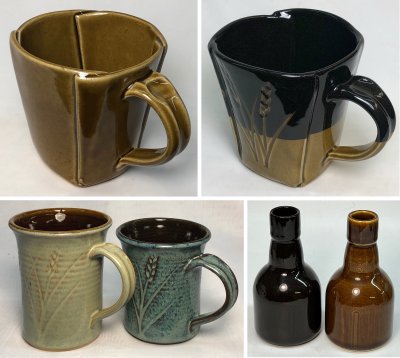
The functional surfaces on these pieces all employ the GA6-B base honey glaze recipe. On Plainsman native stoneware clays, especially darker burning ones, typical transparents are very prone to micro-bubble and clouding issues. But not this glaze. The likely reason is that Alberta Slip contains coarser particles (it is only processed to 42 mesh), these act as a fining agent.
This glaze brings multiple other benefits:
-It fits Plainsman bodies, all of them.
-It is made from materials mined in Canada.
-The Alberta Slip base produces a thixotropic slurry.
-It acts as a very good base for dark colors and black.
The top mugs are GA6-B inside and out (MNS clay body). The top right has a black engobe under it.
Bottom left: GA6-B inside, GA6-C outside (MNS and Coffee Clay)
Bottom right: L4768E Coffee casting and M340 casting.
Context: I drink from these.., This GA6-B glaze is..
Thursday 4th June 2026
Are glazes food safe just because they carry a label?
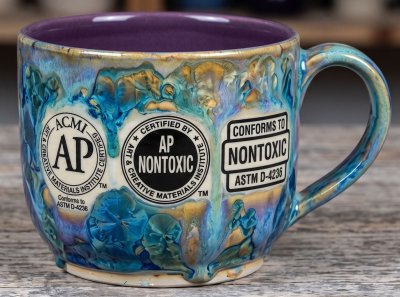
This Gemini-generated mug could conceivably exist yet carry these labels. Yet experienced ceramic technicians would immediately be suspicious. The glaze is highly fluid and heavily crystallized; both suggest low or very low Al2O3 levels (it is the key oxide that makes glazes durable). If the interior color were produced using a cadmium-containing encapsulated stain, cadmium-release testing would be essential before claiming the ware is food safe. This is clearly engineered for visual effects rather than durability. None of those characteristics prove it is unsafe, but they do mean that labels like "nontoxic" are not substitutes for actual leach testing. A glaze can be made entirely from materials classified as nontoxic and still fail to meet the durability standards expected of functional foodware.
Context: Commercial glazes on decorative.., ASTM D-4236 - Standard..
Thursday 4th June 2026
Should I glaze the outside of this mug now? No!

This bisque mug has been glazed on the inside. But the bisque has absorbed water from that glaze, and this thin-walled mug is now waterlogged as a result (except at the thicker base). It does not have the absorbency needed to build up a thick enough layer of glaze on the outside. Even if it did, the water from the two glazes would wet the bisque so much that its drying time would be greatly extended. This is a problem because the mechanism of attachment of glaze to the body is fragile and works best when the glaze dries quickly. When drying is too very slow, bubbling and cracking often occur (leading to crawling in the firing).
Context: Does bisque ware need.., Glaze thickness
Monday 1st June 2026
Yixing teapot making. Is it magic?
Or highly evolved craft and science?
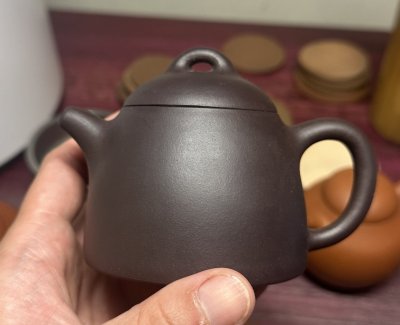
The Yixing teapot craftsmen appear to break all the rules and yet produce impossibly delicate and symmetrical pieces. Hao-Tong Yan, one of those craftsmen, and I have been trying to understand the technical reasons for how this amazing craft is possible. It turns out not to be magic, but actually a highly evolved understanding of a very unusual material. Here are some of the things that we are coming to understand (which is making it possible to create a facsimile of the clay in North America).
-The Yixing ore can have the appearance of being like rocks, yet they make a workable clay body from it.
-The clay appears highly plastic yet is not; the workability is coming from surprising places.
-The clay is stiff enough to resist deformation, yet is cohesive enough to join seamlessly.
-Craftsmen flatten the clay with a mallet, instead of rolling it, yet it does not stick to the board.
-Sections are simply glued with slip, yet they hold.
-The clay burnishes, yet is not smooth.
-Fired ware is smooth, yet the soft clay appears sandy.
-The fired surface is glossy, yet there is no glaze.
-The fired clay appears super dense yet does have porosity.
Context: Yixing Clay Teapots on.., Stunning video of Yixing..
Saturday 30th May 2026
2026: ChatGPT is doing credible troubleshooting
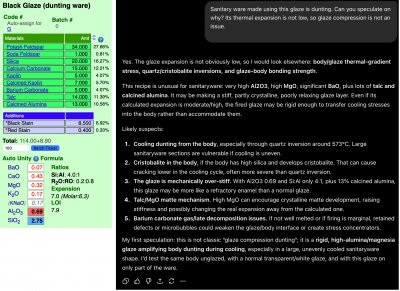
I uploaded a screenshot of this recipe panel from Insight-live and asked ChatGPT why sanitaryware using this glaze is dunting. Its response is impressive, good enough to provide remediation ideas.
-It notes things about the recipe that are unusual. For example, that the Al2O3 of 0.69 and Si:Al only 4:1, plus 13% calcined alumina, make this glaze more like a refractory enamel than a normal glaze.
-Its observation that crystallization could mean the real thermal expansion may be different from the calculated one, maybe much lower.
-Barium carbonate decomposition does not seem like something that would contribute to dunting, but its presence is strange for such a glaze.
Based on its answer, I think the 13% calcined alumina is the wild card, which is way too much for any glaze to dissolve, something to deal with first.
Context: ChatGPT was completely wrong.., ChatGPT is surprisingly wrong.., Two ChatBots square off.., Does ChatGPT know the.., Sanitary ware
Tuesday 26th May 2026
Crystalline glazes normally craze:
Here is one way to fix that
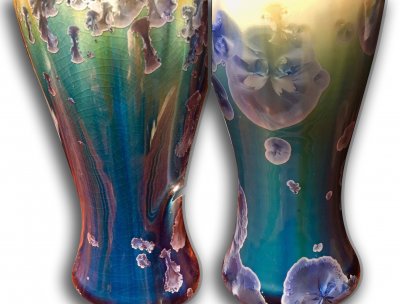
The mug on the left, made by Holly McKeen, is a typical cone 10 Grolleg kaolin mullite porcelain (highly vitrified, low in residual quartz). Its glaze is crazed. Crystalline glazes are high in Na2O, making crazing virtually certain. Since most pieces are decorative, crystal glazers just accept this as part of the process. But these are functional mugs, the glaze needs to fit (if only for ware strength).
But what if the thermal expansion of the body could be significantly raised? The body on the right is Crystal Ice, it contains 40% silica (vs 20-25% in a typical porcelain). The percentage of Nepheline has been reduced, lowering vitrification to about 1.5% porosity. As a result, more quartz survives undissolved and less mullite develops, raising the body’s thermal expansion. The result is a body with a much higher thermal expansion, so it can not only relieve the glaze tension but actually put a squeeze on it. There is a downside: These are less resistant to dunting and thermal shock failure during use.
Could the glaze be adjusted instead? Yes. Some of the Na2O could be substituted for Li2O, the latter is also a strong melter but has a much lower thermal expansion. Glaze chemistry could be used to source it from Spodumene (to avoid solubility issues with lithium carbonate). However, zinc-silicate crystalline glazes are very sensitive systems, so the more lithia is introduced the more likely the effect on the firing window, crystal size/density and background clarity.
Context: Crystalline glazes, Calculated Thermal Expansion
Tuesday 26th May 2026
Incorrect craze-fixing advice is still common online:
Well demonstrated using an AI-generated photo!
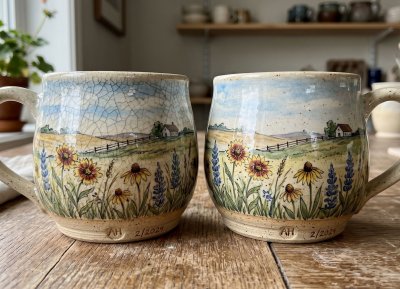
Crazing is one of the most common glaze defects. AI image generators can produce this really convincing photo, but AI explanations often still recycle oversimplified glaze-fit advice from the web. Let's work in reverse to see why using this speckled stoneware, it has lots of ball clay and quartz, it is easy to fit glazes to. What would it take to craze the glaze on the right? A lot. Glazes that craze out of the kiln on quartz-rich bodies are not "slightly misfit"; they are "hugely misfit". Under or over-firing, or holding less time at temperature, would not be enough to craze it. Reducing the silica enough to start severe crazing like this would fundamentally alter the glaze character and functionality.
This is not a recipe-level problem (e.g. reducing feldspar for silica or zinc). This is a material problem; it is an oxide chemistry issue. By far the best way to put the glaze under tension, to craze it, is to trade low thermal expansion oxides (not materials) for high ones. In this case, shift some of the flux unity away from CaO/MgO and toward KNaO (the latter being the highest thermal expansion oxides, by far).
All are fluxes and this is a transparent, so minimal change it character should occur.
Context: Glaze Crazing
Sunday 24th May 2026
Here is what dipping engobes can do:
Go on even. In one coat. Stay put.

When you learn to make and use engobes correctly, they make magic possible. Here I am turning a dark rustic body into a smooth white one (rear mugs) and a white body into a dark one (front). The engobes have been applied at the leather-hard stage. That is the perfect time, the engobe and body are clay bodies, designed to fit each other; they dry together and fire together creating an inseparable bond.
Handles have been applied, and they have dried to stiff leather hard. Engobe was poured in, poured out, then the mugs were pressed, lip down, into it and extracted. No dwell time was needed. This dipping engobe is DIY thixotropic (not available commercially anywhere). That means I tuned it just before use, to just the right degree of gel (enough for it to drain to the right thickness, then gel just as the last few drops fall from the rim). Honestly, these are a beauty to behold at this stage, the silky, drip-free surface is just so perfect.
Context: How stop dripping and.., Here s how we.., Why your supplier does.., Why your supplier does..
Thursday 21st May 2026
Add 6% lithium carbonate to an Alberta Slip glaze:
And this happens!

Left is G3933A, it is an 80:20 mix of our matte and glossy cone 6 base recipes (plus a mix of iron oxide, tin oxide and rutile). The body is Plainsman Coffee Clay. Because of repeated issues with crawling a project was started to create the same effect using Alberta Slip to supply as much of the chemistry as possible. Along that road, the opportunity arose to add lithium (to duplicate Amaco PC-32, a classic Albany/Lithium recipe). That is the glaze on the mug on the right, G3933G1, it has 6% lithium carbonate. Lithium is a super powerful melter, turning this into a very reactive glaze! To make a 500ml jar of brushing glaze, in 2023, required about $7 worth of lithium carbonate.
Context: Lithium Carbonate, GA6-G, Oatmeal glazed mugs, Amaco achieves the stunning.., Recognize these universal oxidation..
Wednesday 13th May 2026
Covia Nepheline Syenite (from Canada):
Here is what it does from cone 3 down to 05
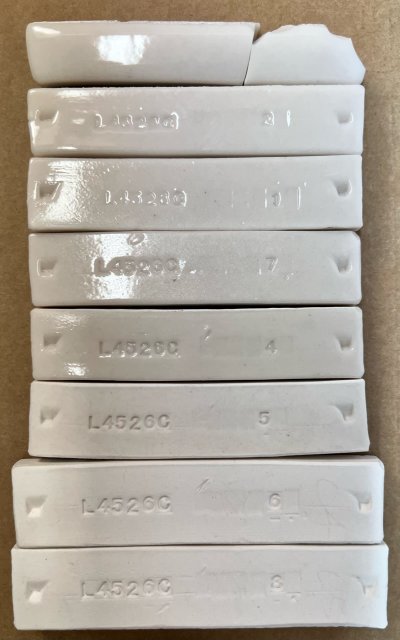
These SHAB test fired bars are 95% nepheline syenite (5% Veegum added). By cone 02 (bar stamped #4) is self-glazing and glass-like with a total shrinkage (plastic to fired) of 15% (less than some porcelains). At cone 03 (the #5 bar) the porosity is 3% (a stoneware). This is not an absolute indication of the materials' melting profile because of the Veegum, it behaves as a powerful flux and melting catalyst.
The Blue Mountain nepheline syenite deposit in Havelock, Ontario, is a major, high-purity industrial mineral source mined since 1955 for glass, ceramics, and filler applications. This 99% pure, iron-poor deposit consists of albite, microcline, and nepheline. It has less than 0.1% free SiO2 and Fe2O3! The deposit is approximately 400 feet deep.
Context: Covia Nepheline Syenite
Tuesday 12th May 2026